
Introduction to Seshat, the Goddess of Math, Measurement and Hemp
The ancient Egyptian goddess Seshat was venerated as the deity of wisdom, writing, and measurement.
Often depicted with a distinctive seven-pointed emblem above her head, Seshat’s iconography and roles suggest a deep association with knowledge and the natural world.
In parallel, hemp (Cannabis sativa) was known in ancient Egypt for its versatile uses … from making ropes and textiles to medicinal and possibly ritual applications.
This report explores all known historical data and interpretations regarding the connection between Seshat and hemp.
We examine documented evidence (Egyptian texts, inscriptions, and iconography) alongside mythological and esoteric theories that link the goddess Seshat to the cannabis plant.
Clear distinctions are made between mainstream academic findings and more speculative or symbolic associations, providing a comprehensive overview of this intriguing topic.
Fun fact about the Word Cannabinoid
The word cannabinoid is a conjucation of Cannabin – from cannabis, and -oid – which is a Greek suffi, a for word-forming piece that stands for “like, or, thing like a ______,” from the Latin form of Greek -oeidēs (three syllables), from eidos “form,” related to idein “to see,” eidenai “to know;” literally “to see” (from PIE *weid-es-, from root *weid- “to see”). (Source: Etmonline, https://www.etymonline.com/search?q=oid)
Seshat: Goddess of Wisdom, Writing, and Measurement
Seshat (ancient Egyptian: sšꜣt, meaning “female scribe”) was a prominent goddess in the Egyptian pantheon, revered as the patroness of writing, knowledge, architecture, and record-keeping.
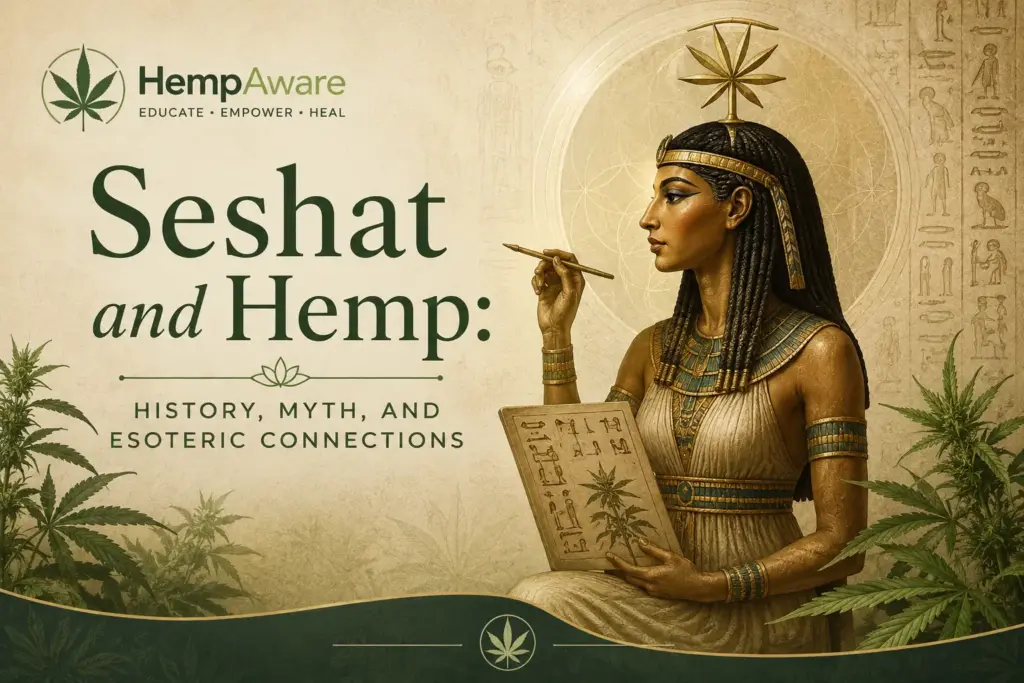
In artwork, she appears as a woman wearing a leopard- or cheetah-skin dress (a garb of ritual priests) with a unique emblem above her head .
This emblem consists of a seven-pointed, star-like figure often surmounted by an inverted crescent or pair of horns.
Seshat typically holds a notched palm rib (the hieroglyph for “year”) to record time, and sometimes knotted cords for surveying land .
As “Mistress of the House of Books” and “Mistress of Builders,” she oversaw temple libraries (the Per-ankh or House of Life) and guided the foundation rituals of sacred structures.
Through these roles, Seshat embodied the Egyptians’ highest ideals of intellectual achievement, orderly creation, and the preservation of knowledge.
Seshat’s emblem has been a subject of debate.
Traditionally, Egyptologists have described the seven-pointed figure as a stylized papyrus flower or a star-rosette symbolizing seshen (papyrus) for writing .
Some have likened it to a palm frond or a composite symbol for cosmic order – Pharaoh Thutmose III even called her “Sefkhet-Abwy,” meaning “She of Seven Points,” in reference to the emblem’s seven-part design.
In many depictions the emblem’s upper part resembles a bent bow or pair of cow horns arching over the seven-pointed shape.
Later Egyptian sources interpreted the seven points as representing seven divine powers or incantations that assist creation.
In short, the iconography of Seshat emphasizes her celestial and intellectual nature – a bridge between heaven and earth through knowledge and measurement.
Cannabis (Hemp) in Ancient Egypt: Documented Evidence
Ancient Egyptians were familiar with hemp, known in Egyptian as šmšmt (transliterated as shemshemet).
Scholars identify shemshemet as cannabis based on multiple lines of evidence, including its use in making rope and medicinal remedies.
While physical remains of hemp in Egypt are relatively rare, a combination of archaeological and textual sources reveals that cannabis was present and utilized throughout much of Egyptian history:
Archaeobotanical finds:
Pollen of Cannabis sativa has been identified at Egyptian sites from the Predynastic period (before 3100 BCE) onward.
Notably, a ball of hemp fiber dating to the 12th Dynasty (~ nineteenth–eighteenth centuries BCE) was documented, and cannabis pollen was famously found on the mummy of Pharaoh Ramses II (13th century BCE) .
These findings indicate hemp plants (or their processed fibers) were present in Egypt’s environment and mortuary context. By the Ptolemaic period (Greco-Roman era), hemp remains also appear in the botanical record .
Textile and rope usage:
Although Egyptians primarily used flax for linen, hemp was valued for its strong fibers. The term shemshemet appears in contexts of rope-making.
An inscription in the Pyramid Texts of King Unas (c. 24th century BCE) describes the king’s ascension to heaven using “twisted shemshemet-plant ropes” to climb to the sky.
Budge’s translation of this passage reads: “He raises up the cords (fibres?) of the shemshemet plant, he unites the heavens.”
This suggests hemp rope was a metaphorical means of reaching the divine, highlighting the plant’s strength and perhaps sacred utility.
(It is worth noting that not all ancient Egyptian ropes were hemp; for example, the famous rope from Khufu’s solar boat was made of halfa grass, not cannabis .)
Nevertheless, by the late period, hemp’s industrial importance was clear enough that Roman authorities imposed a tax on Egyptian hemp in the 3rd century CE , indicating its cultivation and trade at that time.
Medicinal uses in papyri:
Ancient Egypt boasts some of the oldest medical texts, and cannabis features in several remedies.
The Ramesseum Papyrus (c. 1700 BCE) for instance prescribes a treatment for eye ailments involving a mixture of shemshemet (cannabis) and celery ground and left in the dew overnight – the patient’s eyes are to be washed with it in the morning.
The famous Ebers Papyrus (c. 1550 BCE) likewise includes hemp in its pharmacopoeia: it refers to using cannabis as an ingredient in an enema for relieving pain and as a topical poultice for inflammation or infection.
A translated Ebers Papyrus formula reads: “Hemp [shemshemet] is crushed in honey and introduced into the vagina” as a remedy to cool the uterus and induce contraction.
Another Ebers recipe advises a cannabis poultice for toenail pain, and an enema of hemp and honey for digestive aid.
The Berlin Papyrus (c.1300 BCE) recommends hemp leaves boiled in oil as an ointment to treat swelling and inflammation.
In short, Egyptian healers applied cannabis to a wide array of conditions – eye diseases (possibly glaucoma), gynecological disorders, sore fingers or toes, and general pain and inflammation… anticipating some of the same anti-inflammatory and analgesic properties for which the plant is valued today .
Magical and ritual uses:
Beyond practical medicine, cannabis may have had a role in Egyptian magic and religion.
The Ebers Papyrus contains not just recipes but also “magical spells” for healing; notably, some incantations explicitly list cannabis as a required ingredient to be burned or consumed for the spell’s efficacy.
Egyptian physicians were often priest-magicians, and treatments combined herbal remedies with ritual invocation – cannabis could thus be seen as both a physical cure and a magical herb.
In funerary offerings, hemp might have been included as a sacred plant: inscriptions from New Kingdom Theban tombs mention an offering of plants including šmšmt (cannabis) to the deceased, even stating that this “shemshemet-plant was created by Ra”.
This suggests the Egyptians mythologized cannabis as a divine creation of the sun god Ra and used it in mortuary rites (perhaps as incense or an herbal libation) during ceremonies for the dead.
Such fumigations recall the Scythian practice of burning hemp in funerals (as described by Herodotus), hinting at a possible entheogenic aspect in Egyptian ritual as well .
Chemical evidence in mummies:
Modern scientific examinations have indeed detected cannabis or its residues in Egyptian mummies.
When Ramesses II’s mummy was examined in 1981, researchers found traces of cannabis on the pharaoh’s body.
Subsequent analyses of other mummies also uncovered cannabis (and in some cases, THC) in bodily tissues such as lungs.
This strongly implies that cannabis was ingested or smoked by certain individuals before death, possibly as a medicinal treatment for illnesses (e.g. to alleviate pain) or as part of ritual preparations for burial.
The presence of THC in lung tissue, in particular, points to inhalation (smoking or fumigating) of the plant for therapeutic or ritual purposes.
Together, these points paint a picture of cannabis in ancient Egyptian society as a multi-purpose plant.
It provided durable fibers for ropes, sails, and other textile uses, and it served as an important medicinal ingredient in the Egyptian pharmacopeia.
Additionally, cannabis had a spiritual dimension: it appears in magical rites and funerary contexts, and was esteemed enough to be linked to the gods (created by Ra) and used in ceremonies to protect or guide souls.
The Egyptians used the plant in topical, oral, and fumigated forms, but intriguingly, historical sources rarely if ever mention explicit recreational or euphoric use.
This raises the question of whether its mind-altering properties were deliberately exploited or largely esoteric knowledge.
Seshat and Hemp in the Historical Record
What direct connections exist between the goddess Seshat and cannabis/hemp in ancient records?
In truth, no known Egyptian text explicitly names Seshat in connection with the cannabis plant.
Seshat’s extant inscriptions and iconography do not mention her cultivating or using any specific plant. However, there are a few tantalizing intersections in Egyptian lore and symbolism that later commentators have noted:
The “hemp rope to heaven” motif:
Seshat was closely associated with measurement and the laying out of sacred space (the “stretching of the cord” ceremony).
Remarkably, the Pyramid Text of Unas – while not mentioning Seshat by name – describes the king ascending to the stars using ropes made of shemshemet (hemp).
Given Seshat’s role in cosmic order and temple foundations, one might symbolically link this scene to Seshat providing the means (the cord) to connect heaven and earth.
In other words, hemp ropes uniting the heavens evoke Seshat’s function as a bridge to the divine, aligning with her epithet in the Coffin Texts: “Seshat opens the door of heaven for you.”
Seshat’s role in opening the celestial realm to the worthy (the deceased or the learned) is explicitly stated in Spell 10 of the Coffin Texts, which assures the soul that “Seshat opens the door of heaven for you”.
While this line is not about cannabis per se, some later interpreters have seen it as metaphorically resonant with cannabis’s consciousness-altering effects (more on this below).
At minimum, these ancient texts conceptually link Seshat, ropes, and access to the heavens, which sets the stage for interpreting her emblem and rituals in light of hemp.
The House of Life and herbal knowledge:
Seshat was regarded as the patron of libraries and all writings – including scientific and medical texts.
Temples in Egypt often had gardens and archives where priests cultivated and documented medicinal plants.
As “Mistress of the House of Books (Per-Medjat)” Seshat’s priests would have overseen the safeguarding of medical papyri and herbal formulas in temple scriptoriums.
This implies an indirect connection: any plant used in medicine or ritual, cannabis included, fell under the realm of knowledge that Seshat governed.
For example, an ancient Egyptian treatise on herbal remedies that included shemshemet would likely be kept in a House of Life under Seshat’s auspices.
In this sense, one could say Seshat “presided” over the knowledge of cannabis as part of Egypt’s sacred sciences, even if she is not singled out as cannabis’ deity.
Some later writings note that shemshemet was considered a creation of Ra and used by temple priests, knowledge that Seshat, as a deity of wisdom, would symbolically catalog.
Thus, while Seshat is not explicitly a goddess of cannabis, her domain over learning and healing indirectly encompasses the plant’s uses in Egyptian culture.
Iconography of the emblem:
The strongest historical hint of a Seshat-hemp link lies in her headdress emblem.
As mentioned, the emblem is a seven-part figure often described as a star or floral rosette on a pole, topped by a curved arc. No ancient inscription labels this symbol as a specific plant.
However, modern observers cannot help noticing that Seshat’s emblem closely resembles the shape of a cannabis leaf – typically, cannabis sativa has a digitate leaf with five to seven leaflets, often drawn with a pointed, serrated outline not unlike Seshat’s seven-pointed motif.
This resemblance has led to speculation that the emblem was intended to depict a hemp leaf. We will explore this hypothesis in detail in the next section, including scholarly viewpoints and alternative explanations.
In summary, documented links between Seshat and hemp are circumstantial but provocative: the use of hempen ropes in royal rituals that Seshat oversaw, the inclusion of cannabis knowledge in the corpus of Egyptian learning she guarded, and the visual parallel between her seven-pointed crown symbol and the cannabis plant.
These factors have opened the door for various interpretations and theories, ranging from cautious academic commentary to imaginative esoteric narratives.
The Seven-Pointed Emblem: Papyrus Flower or Cannabis Leaf?
One of the central questions in linking Seshat to hemp is the true nature of the emblem she wears on her head.
Egyptologists have long debated what this seven-pointed figure with an overarching curve represents, as it is unique to Seshat. Some key interpretations include:
Papyrus or Palm Frond (Conventional View):
Many scholars favor a botanical explanation related to Seshat’s role in writing.
The papyrus plant – used to make writing scrolls – is often cited.
In art, papyrus is usually depicted with a spiky umbel of multiple leaves; Seshat’s symbol could be a highly stylized papyrus umbel with seven segments (six radiating and one upward).
This would directly link her emblem to the idea of writing and record-keeping (papyrus = writing material).
Alternatively, some see it as a palm branch or frond, since palms were used to mark time (each new palm rib notch = one year) and were sacred in anniversary rites – Seshat did record years and jubilees.
Sir Alan Gardiner, in his Egyptian Grammar (1927), described Seshat’s sign as a “conventionalized flower (?) surmounted by horns,” expressing uncertainty but leaning toward a flora-plus-horns motif.
Indeed, in later periods Seshat was sometimes shown with two long feathers or Ished-tree leaves in place of the horns, reinforcing a vegetal theme to the emblem.
Tamara Siuda, an Egyptologist, notes there is no ancient evidence that this emblem was meant as a marijuana leaf; instead, she explains the seven-pointed star or leaf could symbolize seven guiding spirits (”djȝisw”) who assist goddesses in creation myths.
In this view, the seven “leaves” are a cosmic or magical number rather than a literal plant, and the horns likely relate to a divine cow symbolism (perhaps an upside-down Hathor crown) or a ceremonial bow.
Thus, the mainstream consensus is that Seshat’s emblem is symbolic (representing concepts like writing, years, or cosmic order) and is not an actual depiction of a cannabis leaf .
The Hemp Leaf Hypothesis:
In contrast, a number of researchers and observers … both academic and independent … have proposed that the emblem is intended to be a cannabis (hemp) leaf.
This idea hinges on the visual congruence: Seshat’s star-like emblem typically has seven radiating points, just as a well-formed cannabis leaf has seven leaflets.
Moreover, the combination of a hemp leaf with an overarching curve could cleverly incorporate her tools: the curve could be interpreted as a rolled cord or a measuring bow, and the leaf as the source of the rope material.
H. Peter Aleff, a researcher, articulated this theory in the 1980s, arguing that Egyptian artists often depicted a deity’s principal attributes in their headdress.
According to Aleff, Seshat’s emblem encodes her primary tools – the rope and the plant from which that rope is made.
He notes that five-pointed stars were the norm in Egyptian art for celestial stars, so a seven-pointed figure is unusual and likely deliberate.
Aleff writes: “Her seven-pointed ‘flower’ or ‘star’ is an accurate image of a hemp leaf…
The hemp leaf in Seshat’s emblem is unmistakable evidence that the ancient Egyptian rope-stretchers used hemp for their measuring cords.”
In his view, the emblem’s design ingeniously fuses a leaf (representing the plant used for cordage) with an arc (representing a downturned bow or maybe the curved end of a knotted cord), thus labeling Seshat with the tools of a surveyor.
Proponents of this theory also point out that hemp ropes would have been ideal for measuring since hemp fibers are strong and low-stretch when properly prepared.
The fact that hemp was present in Egypt (if not common) by early dynastic times makes this hypothesis conceivable .
Those who favor the hemp-leaf interpretation further cite supporting “clues”:
For instance, Seshat’s above-mentioned Coffin Text spell about opening heaven’s door is taken as a tongue-in-cheek allusion to cannabis’s ability to “elevate” the mind or soul.
Aleff quips that considering the evidence, Seshat could be “busted” for her “now-illegal patronage of this psycho-active plant” were she operating today.
While this humorous framing isn’t proof of anything, it underscores the pattern of circumstantial evidence: a hemp leaf emblem, hemp rope in ascension rituals, and a goddess granting access to the heavens.
Hybrid interpretations:
Some modern Egyptologists acknowledge the hemp-leaf idea only to refute it gently.
The Seshat Seshkemet project (a modern Kemetic initiative) notes that hemp was known in pharaonic times and Aleff’s argument is “not out of the realm of possibilities,” but concludes it is “however unlikely” in light of Seshat’s long attested history.
They point out that no ancient text explicitly identifies the emblem, and caution that it’s more plausible the symbol relates to known Egyptian iconography (like a palm with attached horns for “New Year”) than a secret cannabis reference.
In other words, while the hemp leaf hypothesis is intriguing, it remains speculative.
There is no record of the Egyptians themselves interpreting Seshat’s symbol as a marijuana leaf, that idea surfaces only in modern times.
In weighing these views, it’s clear the iconography can be interpreted on multiple levels.
The seven-point shape might simultaneously evoke a plant (papyrus or hemp), a star (guiding knowledge), and a numerical magic (seven sacred powers).
Even if the ancient intention was a papyrus flower or abstract star, the uncanny resemblance to Cannabis sativa leaves cannot be unseen, which is why this theory persists in popular and esoteric discourse.
At the very least, the emblem’s likeness to a leaf of Cannabis provides a powerful symbol connecting Seshat to the natural world’s knowledge – cannabis being one of the most notable medicinal plants of the ancient world.
Esoteric and Alternative Theories Linking Seshat to Cannabis
Beyond the academic discussions, a number of esoteric, mythic, or alternative interpretations have flourished around Seshat’s connection to cannabis.
These range from New Age spiritual writings to modern creative re-imaginings of Egyptian mythology. Here we highlight a few notable themes and theories:
Seshat as Cannabis Patron and “Cultivator”:
Some modern storytellers have cast Seshat in the role of a divine herbalist who discovered and disseminated the benefits of cannabis.
For example, a contemporary narrative describes Seshat “among her cherished gardens” finding cannabis and recognizing its healing properties – using her wisdom to teach Egyptians how to cultivate the plant for medicine .
In this telling, Seshat understood cannabis’s ability to “alleviate pain, soothe anxiety, and encourage restful sleep,” and she integrated that knowledge into Egypt’s tradition of healing.
While there is no direct ancient myth of Seshat gardening with hemp, this modern interpretation symbolically aligns with her persona as the giver of knowledge: it imagines her as the one who introduced a valuable medicinal plant to humanity.
Such stories are essentially mythopoetic – using Seshat’s character to celebrate the importance of cannabis in a holistic, wisdom-based culture.
They underscore an ideal that true knowledge includes understanding nature’s pharmacopoeia, something the historical Egyptians indeed valued (their medical texts being evidence of this).
Thus, even if Seshat never literally handed out hemp seeds in pharaonic legend, modern devotees of cannabis sometimes hail her as a patroness of herbal wisdom and medicine, an epithet consistent with her ancient titles.
Cannabis as a Source of Wisdom (“Opening the Doors of Heaven”):
Many alternative theorists draw a parallel between the psychoactive effects of cannabis and Seshat’s ability to bestow wisdom or even transcendence. The Coffin Text spell stating “Seshat opens the door of heaven for you” has been creatively interpreted in this light.
Esoteric writers suggest that using cannabis in a ritual or spiritual context could “open the doors of heaven” by expanding consciousness – essentially letting the user access higher knowledge or divine insight.
In this metaphor, Seshat is the guide or gatekeeper to those elevated states of mind.
For instance, the “Tokin’ Woman” blog mused that “perhaps hemp’s psychoactive effect is acknowledged in the saying that ‘Seshat opens the door of heaven for you.’”.
While this is speculative, it reflects a broader idea in cannabis spirituality: that certain plants can facilitate a connection to the divine or the universe.
Given Seshat’s role as a conduit of divine knowledge (she records the decrees of gods and the fate of humans on the leaves of the sacred Persea tree, according to myth ), linking her with the mind-opening qualities of cannabis becomes an attractive hypothesis for some. It effectively casts cannabis as a sacrament of wisdom, with Seshat as its overseer.
Symbolism of the Leaf and Veil:
A detailed alternative analysis by the Cannabis Rising research blog goes further in allegorical interpretation.
It proposes that the two parts of Seshat’s emblem – the leaf and the arching “veil” above it – represent cannabis and the cosmic wisdom it imparts, respectively.
In this reading, “the leaf is cannabis, and the veil is the wisdom it bestows”, together symbolizing the source of Seshat’s creative ideas and intuition.
Here, cannabis is not just a plant but a metaphorical veil-lifter, aligning with modern testimonies of cannabis inspiring creativity and insight.
The blog argues that nothing in Seshat’s character contradicts the possibility of cannabis use – she is a “smart, colorful and spirited” goddess, and the creative, introspective effects reported by many cannabis users (even noted intellectuals like Carl Sagan, who spoke of cannabis enhancing cosmic curiosity ) would fit her profile.
Essentially, this theory repackages Seshat as a kind of muse of cannabis: the plant’s influence is equated with flashes of knowledge, the “cosmic intuition” that Seshat embodies.
It must be emphasized that such interpretations are modern conjectures – ancient Egyptians did not explicitly link Seshat to a drug-induced state of mind.
However, the concept resonates with the known Egyptian use of other entheogens (like the Blue Lotus in wine) to reach altered states during rituals.
It’s plausible that if priests or initiates ever partook in a hemp-infused incense or beverage to enhance ritual focus, they might invoke Seshat’s name to guide the ensuing visions or understanding.
Comparative mythology and “hidden” use:
Some alternative historians point out that Egyptians’ neighbors (such as the Scythians, Canaanites, and later cultures) did use cannabis ritually – for example, burning it in tents or temples to produce trance-inducing smoke.
They argue it is unlikely the Egyptians were oblivious to these properties when they actively traded with cultures that prized cannabis’s intoxicating qualities.
Rosalie David, a reputable Egyptologist, has acknowledged that the ancient Egyptians “certainly used drugs” like lotus, mandrake, cannabis, and opium in various contexts.
This lends credence to the idea that cannabis could have been secretly used in religious ceremonies (perhaps mixed into the famous kyphi incense or the mythical potion “nepenthe” that alleviates sorrow).
If so, Seshat’s priesthood – keepers of secret knowledge – might have been among those who guarded and employed such uses.
However, because Egyptian religious texts are often cryptic or symbolic, definitive proof is lacking.
This gap between what may have happened and what was openly recorded is precisely where esoteric theories thrive.
They posit that cannabis’s visionary use was a “veiled” practice, hinted at through symbols (like Seshat’s emblem or the idea of “opening heaven’s door”) and only fully understood by initiates.
In this view, Seshat’s association with cannabis is part of a hidden tradition of using sacred plants to achieve higher consciousness, a tradition that had to be encoded subtly within the iconography and myths.
Broader Context and Conclusion
Investigating Seshat’s connection to hemp illuminates a fascinating intersection of ancient evidence and modern interpretation.
On one hand, the documented historical data shows that cannabis was indeed known to the ancient Egyptians and valued for practical purposes: it was used to make rope and fabrics, to treat pain and illnesses, and to perform magical rites.
Hemp was not the most common crop in Egypt’s flax-dominated textile economy, but it was present from at least the Old Kingdom onwards, with its usage becoming more evident in later periods.
The goddess Seshat, as the personification of learning, would have presided (at least figuratively) over the incorporation of such a useful plant into Egyptian knowledge systems.
Seshat’s own sphere – recording and preserving knowledge – means any medicinal or technical knowledge about cannabis could be seen as part of her domain.
On the other hand, mythological and esoteric associations between Seshat and cannabis showcase how later generations seek deeper meaning in the ancient symbols.
The striking visual similarity of Seshat’s seven-pointed emblem to a cannabis leaf has led some to re-imagine her as a patron of the cannabis plant, a conduit through which divine knowledge (perhaps accessed in altered states) flows to humanity.
These interpretations, while not substantiated by explicit ancient texts, highlight a symbolic truth: both Seshat and cannabis are linked to wisdom, healing, and transcendence.
Seshat represents the ordered knowledge of the heavens and earth; cannabis, in the eyes of many cultures, is a plant that blurs the boundary between the mundane and the visionary.
In academic consensus, there is no direct evidence that Seshat was historically worshipped as a cannabis deity – her emblem is officially unexplained, and most Egyptologists favor a non-cannabis interpretation (papyrus, star, or palm).
Furthermore, scholars like J. F. Nunn have noted that ancient Egyptian sources, while using cannabis medicinally, give “no clear evidence of awareness of [its] effects on the central nervous system” , implying it was not overtly used to induce ecstasy or inspiration in the way it might be in shamanic cultures.
However, others like Rosalie David counter that Egyptians did know and use psychoactive plants including cannabis , so the absence of open mention could be due to esoteric secrecy or simply the loss of certain records.
Ultimately, the connection between Seshat and hemp remains a blend of fact and conjecture.
Historically, Seshat stands as a symbol of intellectual achievement – the very kind of advancement that includes developing herbal medicines and natural technologies like rope-making.
Cannabis was one of the myriad tools the ancient Egyptians had at their disposal for such advancements, from architecture (rope surveying lines) to healing (pain relief).
In a metaphorical sense, then, hemp was under Seshat’s purview as much as mathematics or writing.
Mythologically and in modern thought, this connection is deepened by viewing cannabis as a plant of knowledge and enlightenment, making Seshat a fitting patron for its higher uses.
In conclusion, while no pharaoh left an inscription explicitly thanking Seshat for the gift of cannabis, the threads of evidence and legend weave a compelling story: Seshat the wise, with her seven-pointed crown, and hemp the ancient healer, with its seven-pointed leaf, intersect at the crossroads of nature, wisdom, and the quest for eternal truth.
This nexus of ancient Egyptian history and esoteric symbolism continues to inspire research and imagination alike.
As our understanding evolves – through archaeology, botany, and comparative mythology – we gain ever more appreciation for how the ancients might have integrated sacred plants into their spiritual worldview, perhaps under the gentle guidance of goddesses like Seshat, the keeper of knowledge.
Q: Who exactly was Seshat in ancient Egyptian culture and what was her connection to knowledge and writing?
A: Seshat, the goddess of writing, was one of ancient Egypt’s most intellectually powerful deities, often depicted as a woman wearing a distinctive seven-pointed emblem above her head.
She served as the divine scribe and record-keeper, working closely with Thoth, the god of wisdom, to document everything from royal annals to astronomical observations.
Seshat was associated with measuring land and structures through the sacred ritual called “stretching the cord,” which laid the foundations for temples like Karnak.
She’s often depicted holding a palm stem for recording the passage of time and wore a distinctive leopard-skin robe, marking her elevated status among Egyptian deities.
Q: Is there really evidence of cannabis in ancient Egypt, or is this just modern speculation?
A: The history of cannabis in ancient Egypt is surprisingly well-documented! Archaeological evidence confirms that cannabis was used as early as the Second Dynasty, with traces found in ancient Egyptian medical texts and physical remains.
The plant appears in various medicinal preparations, suggesting ancient Egyptians valued cannabis for its healing properties. While some scholars debate the extent of its use, hieroglyphic references and botanical remains indicate that cannabis may have been used both therapeutically and possibly in religious contexts, making it more than mere modern wishful thinking.
Q: What’s the deal with the seven-pointed leaf symbol on Seshat’s head—could it be a hemp leaf?
A: Here’s where things get deliciously mysterious!
The seven-pointed emblem that sits atop Seshat’s head has puzzled Egyptologists for centuries.
Some esoteric researchers have suggested this symbol resembles a seven-pointed hemp leaf, proposing that Seshat was associated with the cannabis plant due to its consciousness-expanding properties that might aid in accessing divine knowledge.
While mainstream archaeology typically identifies this as a stylized star or flower, the similarity is striking enough that the alternative interpretation continues to spark fascinating debates about ancient symbolism and the role cannabis may have been used in scribal or priestly practices.
Q: How did Seshat and Thoth work together in ancient Egyptian mythology?
A: Think of Seshat and Thoth as the ultimate power couple of ancient Egyptian knowledge management
While Thoth held the title of god of wisdom and was credited with inventing writing itself, Seshat was his female counterpart and equal partner in intellectual pursuits.
She often appears recording important events on the leaves of the Ished Tree, the sacred tree of life, while Thoth handles the broader magical and lunar aspects of wisdom.
Seshat also specialized in practical applications like astronomy, architecture, and mathematics—she was the deity you’d want when precision mattered, whether surveying land for a pharaoh like Hatshepsut or recording strain measurements for temple construction.
Q: What was the “stretching the cord” ceremony that Seshat performed?
A: “Stretching the cord” was ancient Egypt’s version of a divine groundbreaking ceremony, and Seshat was the star of the show!
This sacred ritual involved the pharaoh and Seshat using ropes to measure and align the foundations of temples and important structures according to astronomical observations.
The ceremony ensured buildings were cosmically aligned and properly proportioned—essentially combining surveying, astronomy, and religious ritual into one spectacular event.
Major constructions like the temples at Karnak would have begun with Seshat’s blessing through this ceremony, demonstrating how she connected divine knowledge and writing with practical applications in land and structures.
Q: Why did Seshat wear a leopard-skin robe, and what did it symbolize?
A: The leopard skin worn by Seshat wasn’t just a fashion statement—it was a powerful symbol of her priestly status and connection to the divine realm! In ancient Egyptian culture, leopard-skin garments were reserved for high-ranking priests and deities involved in the most sacred rituals.
Being depicted holding or wearing this distinctive spotted hide marked Seshat as someone who operated between the earthly and divine worlds.
Some esoteric interpretations suggest the spots represented stars or seeds, possibly connecting her to both astronomical knowledge and plant wisdom, including the controversial theory that she was associated with the cannabis plant as a tool for accessing higher consciousness.
Q: What role did cannabis play in ancient Egyptian medical practices?
A: Ancient Egyptian medical texts reveal that cannabis was a go-to remedy in the pharaonic pharmacy!
Medical papyri describe cannabis being used to treat inflammation, glaucoma, and various painful conditions—the ancient Egyptians clearly recognized cannabis for its healing properties.
The plant was typically prepared as topical applications, suppositories, or infusions, showing a sophisticated understanding of different administration methods.
While we can’t definitively link Seshat directly to medical cannabis use, her role as keeper of knowledge would have included overseeing the recording of these medical formulations in the royal annals and temple libraries, making her the divine archivist of ancient pharmaceutical wisdom.
Q: How does the symbol of the palm stem relate to Seshat’s duties?
A: Seshat carries a palm stem as her primary tool for recording history and measuring the passage of time—think of it as her divine tablet and stopwatch combined!
The notched palm rib served as an ancient calculator for counting years and recording significant events, which Seshat would inscribe in hieroglyphic form.
This simple yet elegant tool connected her to the measurement of royal reigns, astronomical cycles, and the documentation of important achievements. The palm stem, combined with her seven-pointed leaf on her head, created a complete symbol system representing Seshat’s dominion over recorded knowledge, temporal measurement, and the preservation of wisdom across generations.
What does the name Seshat mean?
Seshat’s distinctive headdress, shown here as a hemp leaf, functions as a compact symbol that links her roles and the practical uses of hemp.
- Identity and authority: the hemp leaf marks Seshat as the goddess of record‑keeping and ritual knowledge, a clear visual identifier in art and inscriptions.
- Writing and record materials: hemp symbolizes the raw plant fiber used to make cords, cordage for measuring, and media for inscription—connecting Seshat to the tools of scribes and architects.
- Measurement and surveying: hemp ropes were essential for laying out buildings and boundaries; the leaf indicates her authority over measuring, planning, and maintaining order.
- Binding and construction: the hemp leaf evokes the plant’s fibrous use in binding and construction, tying Seshat to the practical craft skills involved in architecture and temple building.
- Fertility, protection, and ritual: as a plant symbol, the hemp leaf also suggests growth, durability, and protective qualities used in rituals she supervises—linking her to blessings over foundations, records, and lineage.
In sum, the hemp leaf headdress compresses Seshat’s domains—writing, measurement, construction, and ritual—into a single plant emblem that emphasizes both symbolic authority and the everyday, material uses of hemp in ancient practice.
Sources
- Writings and iconography of Seshat in ancient Egyptian texts and art.
- Evidence of cannabis (hemp) in Pharaonic Egypt – medical papyri, archaeological finds, etc..
- Interpretations by Egyptologists (e.g. Dawson, Manniche, Nunn) on shemshemet = cannabis and its uses ; debates on psychoactive use.
- Pyramid Text of Unas and Coffin Text Spell 10 referencing Seshat/heaven and hemp ropes.
- Alternative theories: H. P. Aleff’s hemp-leaf emblem hypothesis ; modern esoteric interpretations linking Seshat’s emblem to cannabis and wisdom.
- Dragonwear Journal – “The Goddess Seshat: Keeper of Knowledge” (2024) and “Ancient Egypt & Hemp” – modern summaries linking Seshat with hemp’s importance.
- Cannabis Culture Magazine – “Shemshemet: Cannabis in Ancient Egypt” (2021) – compilation of historical evidence and Aleff’s theory.
- Veriheal Blog – “How was Weed Used in Egyptian Culture?” – discussion of Egyptian cannabis use and the Seshat-cannabis speculation.
- Tamara L. Siuda (Patreon, 2024) – “Netjer of the Week: Seshat” – scholarly insight into Seshat’s emblem (rejecting cannabis interpretation).
- Cannabis Rising Blog – “Seshat’s Secret” (2012) – in-depth esoteric analysis of the Seshat emblem as cannabis leaf and “veil of wisdom”.
Each of the above sources contributes to a multifaceted understanding of Seshat’s potential relationship with hemp, bridging the gap between established historical knowledge and the mythic imagination that surrounds this enigmatic goddess of knowledge.